
What DevOps Engineers Do, Skills Needed, and Career Path
What does a DevOps engineer do? Get the real job duties, must-have skills, salary ranges, and career path explained simply.

A DevOps engineer builds and runs the pipelines, infrastructure, and tooling that keep software shipping and production healthy. The job sits between development and operations, which used to be two separate teams that handed work back and forth with tickets and meetings. A DevOps engineer removes most of that handoff by automating builds, deployments, monitoring, and recovery. That means fewer people waiting on each other and fewer outages caused by manual steps done wrong at 2 a.m.
Demand for this role keeps climbing as more companies move workloads to the cloud and need someone who can run that infrastructure reliably. Job boards show hundreds of new DevOps and SRE postings added every day, with companies hiring across industries from tech to retail to government contracting. Pay reflects that demand too, with senior infrastructure and SRE roles often listed well into six figures. Companies moving to Azure, AWS, or Google Cloud still need engineers who understand CI/CD, observability, and incident response, so the skill set stays in demand even as the tools shift.
Table of Contents
Where DevOps Fits In Modern Engineering Teams
The title came out of the 2000s split between developers who wrote code and operations teams who ran servers. Those two groups rarely talked outside of handoff tickets, and deployments were slow because of it. DevOps grew as a practice that merged both jobs into one skill set, so the person writing automation also owns how it runs in production.
The job title overlaps heavily with SRE, platform engineer, and cloud engineer, and job postings often use them loosely. Each one has a different center of gravity even when the daily tasks look similar.
| Role | Main focus | Typical tools |
|---|---|---|
| DevOps Engineer | Build and automate CI/CD pipelines | Jenkins, GitHub Actions, Terraform, Docker |
| Site Reliability Engineer | Keep services inside SLOs | Prometheus, Grafana, PagerDuty, Kubernetes |
| Cloud Engineer | Design and run cloud infrastructure | AWS, Azure, GCP, CloudFormation |
| Platform Engineer | Build internal tools for other engineers | Backstage, Crossplane, internal APIs |
A hiring manager at a startup might post one role and call it all four names in the same listing. Reading the actual task list in a posting tells you more than the title does, something a more detailed breakdown covers at DevOps engineer: A complete guide to skills and career path.
Daily Work A DevOps Engineer Actually Handles
A normal day splits between building things and fixing things. Writing and maintaining CI/CD pipelines takes up a big chunk of time, since every code change needs a safe, repeatable way to reach production without someone manually running deploy scripts at night.
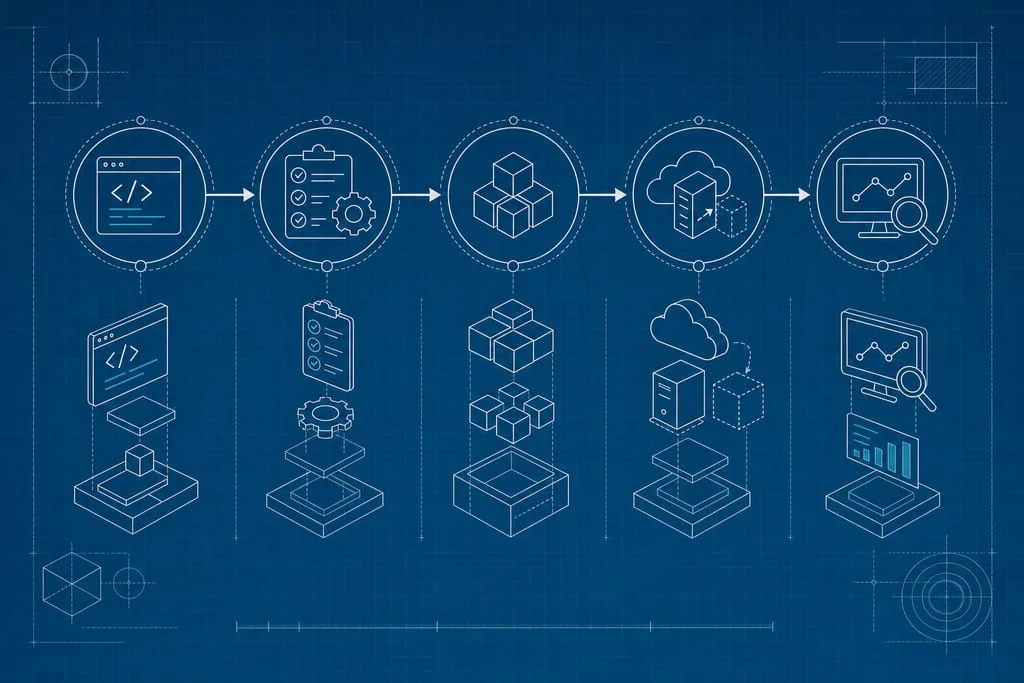
Cloud infrastructure work fills the rest of the build side. Terraform, CloudFormation, or native console work on AWS, Azure, or GCP gets used to stand up servers, networking, and storage as code instead of clicking through a dashboard each time.
Monitoring and incident response is the other half of the job. Services get watched against SLOs, and when something breaks, the engineer on call has to find the cause and fix it fast, because every minute a service stays down past its SLO counts against the team.
Scripting ties it together. Python, Go, and Bash scripts automate the repetitive stuff, from rotating credentials to cleaning up logs, so engineers aren't doing the same manual task every week.
- CI/CD: GitHub Actions, Jenkins, GitLab CI
- Infrastructure as code: Terraform, CloudFormation, Pulumi
- Monitoring: Prometheus, Grafana, Datadog
- On-call tools: PagerDuty, Opsgenie
Core Skills That Get DevOps Engineers Hired
Hiring managers screen for a mix of coding ability and operations know-how. Scripting languages like Python and Go show up in most job postings, and Java or TypeScript appear often for teams working closer to the application layer.
Cloud platform experience is non-negotiable at this point. Postings ask for hands-on work with AWS, Azure, or GCP alongside infrastructure as code tools like Terraform, since almost every DevOps listing now names at least one cloud provider by name.
Containers and orchestration round out the technical list. Docker and Kubernetes knowledge gets treated as baseline, not a bonus, especially for roles tagged platform engineering or distributed systems.
Observability and incident response skills matter just as much as the coding side, and so does the ability to explain an outage clearly to people who aren't engineers.
- Scripting: Python, Go, Bash, sometimes Java or TypeScript
- Cloud and IaC: AWS, Azure, GCP, Terraform
- Containers: Docker, Kubernetes
- Observability: Prometheus, Grafana, log aggregation tools
- Communication: clear incident writeups, cross-team coordination
The list of in-demand DevOps skills for hiring in 2026 tracks closely with what shows up in current postings.
How Pay And Demand Break Down By Experience
Pay scales hard with experience and location. Entry-level infrastructure roles start in the low six figures at large companies, while senior and staff-level SRE or platform roles push well past $200k depending on the market.
Current postings show that range in action: a senior core infrastructure role in Nashville lists $79k to $209k, an infrastructure engineer role in Virginia lists $164k to $201k, and a backend infrastructure role in San Francisco lists $235k to $260k. A senior SRE role in Lisbon lists €110k to €220k, which shows the same seniority spread plays out in euros too.
Work arrangement affects both pay and availability. Onsite roles at companies like Oracle still pay competitively, remote roles widen the applicant pool and sometimes narrow the range, and hybrid roles tend to sit in the middle.
Daily postings stay steady across all experience levels, so there's no single week where only junior or only senior roles show up.
- Entry to mid: roughly $79k to $165k in current postings
- Senior and staff: roughly $164k to $260k depending on city
- Remote roles often widen the pool and flatten the range
- Onsite roles at large firms still pay at the top of the range
The Career Path From Junior To Senior DevOps
Most DevOps engineers don't start with that title. Sysadmin work, IT support, or a junior developer role are common entry points, since those jobs teach the systems basics that DevOps work builds on.
Mid-career, people move into titles like DevOps engineer, cloud engineer, or SRE, often by picking up scripting and cloud platform work on top of their existing job. That's the stage where Terraform, Kubernetes, and CI/CD pipeline ownership start showing up on a resume.
Senior paths lead toward platform lead, staff engineer, or infrastructure architect roles, where the job shifts from running pipelines to designing systems other teams build on. Each step up tends to trade hands-on pipeline work for more design and cross-team decision-making.
Some engineers move sideways instead of up, taking their infrastructure background into cloud security engineering, where the daily work still touches cloud platforms and automation but the focus shifts to securing them.
- Sysadmin, support, or junior developer
- DevOps engineer, cloud engineer, or SRE
- Platform lead, staff engineer, or infrastructure architect
- Lateral move into cloud security engineering
Staying In DevOps Versus Moving To A Specialized Track
DevOps hiring has not slowed down. Amazon, Oracle, and Deloitte all show up in current postings for infrastructure and reliability work, alongside government contractors and retail IT shops, which means the demand sits across industries, not one shrinking niche.
The real choice isn't DevOps versus no DevOps. It's generalist versus specialist, and each path costs something different.
| Path | What it costs you | What it pays off in |
|---|---|---|
| Stay generalist DevOps | Slower pay growth at senior levels | Flexibility to move between teams and industries |
| Specialize in observability | Months learning Prometheus, Grafana, tracing tools deeply | Premium pay on SRE and platform postings |
| Specialize in Kubernetes | Time mastering orchestration beyond basic Docker use | Better fit for platform engineer roles, higher base pay |
| Move to cloud security | New domain knowledge, slower initial ramp | Access to a less crowded, higher-paying field |
Generalist DevOps work still fits engineers who want options over specialization, since the skill set carries straight across to SRE, platform, and cloud security titles without a career reset. That transfer is what keeps the risk low even when one company or sector slows hiring. Specializing costs ramp-up time but tends to show up in the higher end of the pay ranges, which lines up with how Coursera's DevOps career guide frames the next few years of demand. The generalist path works for someone early in the role or still figuring out which direction fits; the specialist path works for someone who already knows they want to go deep in one area and is willing to spend months building that depth before it pays off.
Check Your Skills Against Real Postings Before You Apply
Pull up three or four current postings for the title you want and line up your actual skills against the requirements listed, not the job title. If a posting wants Terraform, Kubernetes, and on-call experience and you only have two of three, that role is a stretch, not a fit, and your time is better spent on one where you match most of the list. Apply to roles that match your experience level now, not the one you're six months from being ready for. DevOps Jobs keeps listings narrowed to DevOps, SRE, platform, and cloud infrastructure work, so you're comparing your skills against relevant postings instead of digging through generic IT and support roles to find the few that fit.
DevOps Career Questions People Still Ask
Do I need a computer science degree to become a DevOps engineer?
No. Most hiring managers care more about hands-on skills with Terraform, Kubernetes, and a cloud platform than a degree. Plenty of DevOps engineers come from sysadmin work, military IT, or self-taught scripting backgrounds. A degree can help at large companies with strict HR filters, but a portfolio of real automation work and cloud certifications usually carries more weight in the actual interview.
Can a sysadmin switch into DevOps without starting over?
Yes, and it is one of the most common paths into the role. Sysadmin work already covers servers, networking, and troubleshooting under pressure, which overlaps heavily with DevOps daily tasks. The gap to close is usually scripting and infrastructure as code, since sysadmins often manage systems by hand instead of through Terraform or a CI/CD pipeline. Picking up one cloud platform and one IaC tool closes most of that gap.
Is it better to specialize in one cloud provider or learn multiple?
Start with one cloud provider and go deep before spreading out. Most postings name AWS, Azure, or GCP specifically, and hiring managers want someone who can move fast in the platform they already run, not someone with shallow exposure to all three. Once you have a certification and real project work in one provider, picking up a second becomes much faster since the core concepts, networking, IAM, and compute, carry over.
How do I find DevOps job postings without wading through unrelated IT listings?
Use a job board built specifically for DevOps and SRE roles instead of a general tech job site. DevOps Jobs keeps its listings narrowed to DevOps, SRE, platform, and cloud infrastructure postings, pulled from thousands of companies hiring now, so you're not filtering generic IT, sysadmin, or support roles out of a mixed feed. That narrower list cuts the time you spend screening postings that were never going to fit.