Platform Engineer vs Software Engineer Which Path Fits?
Platform engineer vs software engineer: compare daily work, skills, and pay to decide which career path fits your strengths best.
By David Nix
Published

The short answer to platform engineer vs software engineer is that one builds the tools engineers use to ship code, and the other builds the product that customers use. A platform engineer spends the day on internal systems: CI/CD pipelines, Kubernetes clusters, provisioning tools, golden paths for deployment. A software engineer spends the day inside the product codebase, writing features, fixing bugs, shipping things a paying customer will click on. That split in daily focus is the whole difference, and it shows up in the job title, the team you sit on, and the metrics you get judged by.
This split matters more now because companies are standing up dedicated platform teams separate from product teams, instead of folding infrastructure work into generic backend roles. A company might have one team building the checkout flow and a completely separate team building the internal deploy tool that checkout flow runs on. Knowing which side fits you helps you aim your resume and your interview prep at the right track, since the skills, the on-call load, and the kind of problems you solve are not the same.
Table of Contents
Why This Comparison Keeps Coming Up
Platform engineering did not exist as a named job track twenty years ago. It grew out of DevOps, once companies realized that asking every product team to manage its own Kubernetes setup and CI pipeline was wasteful, so they built dedicated platform teams to run internal developer platforms instead. Red Hat frames this shift as platform engineering taking the DevOps mindset and packaging it into a reusable, self-service product for other engineers, rather than leaving each team to reinvent its own tooling (source).
Software engineering never went anywhere. It is the older, broader discipline, and it stayed focused on building the applications and features that generate revenue, long before platform teams had a name.
Both roles write code daily, but they write it for different audiences and get judged on different things.
| Factor | Platform Engineering | Software Engineering |
|---|---|---|
| Emerged as a field | Mid-2010s, from DevOps | Since the start of computing |
| Main customer | Internal engineering teams | External end users |
| Core deliverable | Self-service tooling, golden paths | Product features, bug fixes |
| Success measure | Deploy frequency, platform adoption | Feature shipped, user growth |
What Fills Each Role's Workday
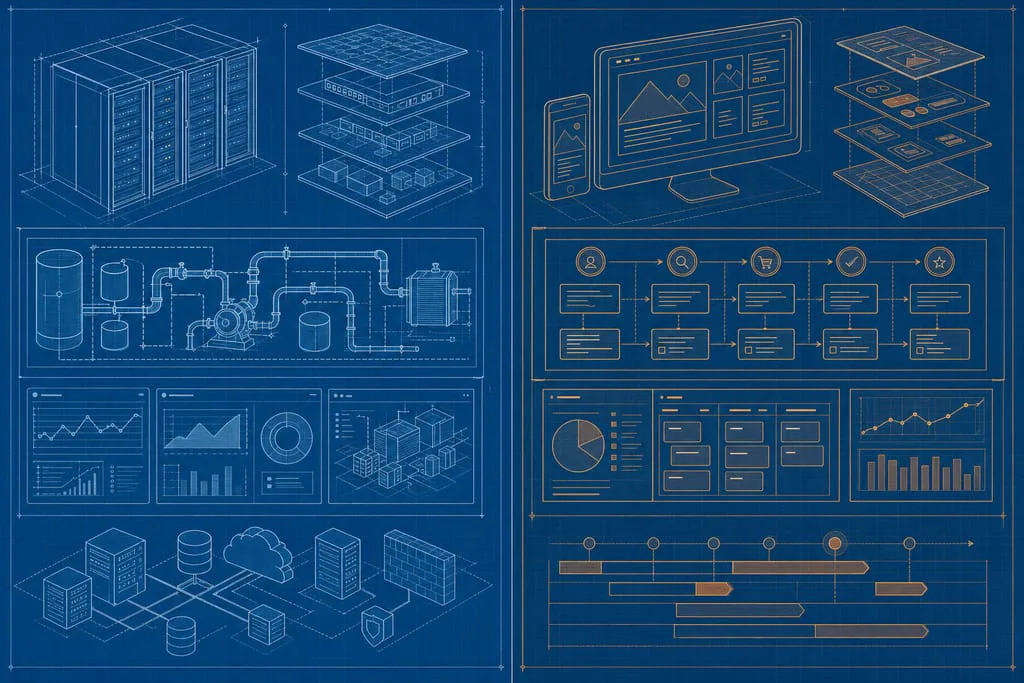
A platform engineer's day centers on building self-service tools, CI/CD pipelines, and internal platforms that other engineers use to ship their own code faster. A software engineer's day centers on writing application code, fixing bugs, and turning product requirements into working features for customers. The clearest way to tell these roles apart is to ask who the work serves.
- Platform engineer's customer: other engineers on the team
- Software engineer's customer: end users or paying clients
- Platform engineer's roadmap: tied to infrastructure priorities
- Software engineer's roadmap: tied to product priorities
- Platform engineer's output: pipelines, provisioning tools, golden paths
Meetings follow the same split. Platform teams review deploy frequency and platform adoption, while product teams review feature timelines and user feedback. The customer you build for is the single fact that decides which job you're actually doing, no matter what the title on the posting says.
Skills That Get Each Role Hired
Companies hire platform engineers for cloud infrastructure depth and hire software engineers for application-level coding strength, and the gap between those skill sets is wide. Platform roles want hands-on work with Kubernetes, Terraform, and a language like Go or Python used for building internal tooling rather than product features. Software roles want strong command of Java, TypeScript, or Python paired with solid data structures and algorithms, since interviews still lean on that foundation.
- Platform engineer must-haves: Kubernetes, Terraform, cloud infrastructure, observability
- Software engineer must-haves: a primary language, data structures, algorithms, frameworks
- Shared ground: version control and automated testing, though the depth of use differs
- Platform bonus: distributed systems and CI/CD pipeline design
- Software bonus: product thinking and framework fluency
Both tracks expect comfort with Git and test automation, but a platform engineer is judged on how reliable the systems stay, while a software engineer is judged on how well the feature works for users. That difference in judgment criteria is what recruiters are actually screening for behind the skill list.
Pay, Demand, and Where Jobs Are Posted
Platform engineering pay now overlaps heavily with senior software engineering pay, based on listings currently posted. An AI Platform Engineer role at ambi. in hybrid Lisbon lists €110k to €160k/yr, and a Senior Core Infrastructure Engineer role at Oracle in Nashville lists $79k to $209k/yr depending on level. Software engineering pay spreads just as wide, since it depends heavily on company size, stack, and whether the role touches infrastructure at all.
- AI Platform Engineer, ambi., hybrid Lisbon: €110k to €160k/yr
- Senior Core Infrastructure Engineer, Oracle, onsite Nashville: $79k to $209k/yr
- Infrastructure Engineer, General Dynamics IT, remote Virginia: $164k to $201k/yr
Demand for platform roles is climbing as more companies stand up internal developer platforms instead of leaving infrastructure to individual product teams. Listings for platform and infrastructure work are showing up alongside senior software roles in the same pay bands, which means the old assumption that infrastructure pays less than product work no longer holds up.
Which Background Points You Toward Each Path
Your existing experience usually points you toward one path before you even apply. Engineers coming from sysadmin, DevOps, or SRE backgrounds tend to move into platform engineering naturally, since they already think in terms of uptime, pipelines, and provisioning. Engineers coming from computer science backgrounds focused on building apps usually fit better as software engineers, since their instincts run toward features and user flows.
- Sysadmin or DevOps background: strong fit for platform engineering
- App-focused CS background: strong fit for software engineering
- Enjoys building tools teammates use: lean platform
- Enjoys building things end users touch: lean software
- Comfortable moving between both over a career: hybrid track is real
Plenty of engineers switch tracks more than once in a career, so picking a lane now does not lock you out of the other one later. If you're weighing both paths while job hunting, a focused board that tags roles by skill set, the kind DevOps Jobs runs, makes it easier to compare real postings instead of guessing from a title alone.
Why The Posting Matters More Than The Title
Two companies can slap "Platform Engineer" on wildly different jobs. One posting means a team running Terraform modules and internal CI tooling for other engineers. The other means someone writing backend services who happens to touch Kubernetes once a month, and the title got picked for recruiting reasons, not job design.
Skill tags cut through that noise faster than any title can. A posting tagged Distributed Systems, Observability, and Incident Response is describing platform or SRE work, no matter what the job title says above it. A posting tagged Microservices, TypeScript, and a framework name is describing product engineering, even if someone called it a platform role to sound more technical.
- Distributed Systems, Observability, Incident Response: points to platform or SRE work
- Microservices, a frontend framework, product-focused language pairings: points to software engineering work
- Kubernetes, Terraform, CI/CD pipeline design: points to platform work regardless of title
A narrower search makes this easier to catch, since you are scanning fewer listings and can actually read what each one lists instead of skimming thirty titles that all say the same thing. Sites built specifically around DevOps, SRE, and infrastructure roles show those tags up front instead of burying them in a long description, which cuts the guesswork down to a scan instead of a read.
Pick A Lane And Check Today's Postings Against It
Open a batch of current listings tonight and sort them by skill tag, not job title. Pull up five platform postings and five software postings, then check which tag cluster matches what you've actually built: Terraform and Kubernetes work on one side, a product language and a frontend framework on the other. If you've got one foot in both, apply to whichever cluster has more tags you can speak to in an interview without stretching the truth. DevOps Jobs sorts listings this way by default, so the tags sit next to the title instead of three paragraphs down. Thirty minutes of scanning real postings will tell you more about which track fits than another week of thinking it over.
Common questions
Can a software engineer become a platform engineer without infrastructure experience?
Yes, but you need to build hands-on proof first, not just read about it. Spin up a home lab with Kubernetes, write a few Terraform modules, and contribute to your company's CI/CD pipeline if you can get access. Hiring managers want to see work you've actually done with these tools, not a list of tools you've read about.
Do platform engineering roles require more on-call work than software engineering roles?
Platform roles usually carry heavier on-call load because the systems they run, like Kubernetes clusters and deploy pipelines, affect every other team the moment something breaks. Software engineers get paged too, but usually only when their specific service fails. Ask about on-call rotation frequency and pay during the interview, since it varies a lot by company and team size.
Is it harder to switch from platform engineering back to software engineering later?
No, the switch back is usually easier than people expect, since platform engineers still write code daily and stay sharp on data structures and systems design. The harder part is refreshing product-specific skills like frontend frameworks if you've been away from them for years. Keeping a side project in a product language helps bridge that gap before you need to make the jump.
Which path has more job security if a company cuts engineering headcount?
Neither path is immune, and layoffs usually hit based on team size and revenue impact rather than job title. Platform teams can look like overhead to leadership during cuts, since they don't generate revenue directly, while product teams tied to a shrinking feature can get cut just as fast. Checking a company's engineering headcount trend on sites like Glassdoor before applying tells you more than guessing from the job title.